MENU
ID | IDR

ID | IDR
-
- All Pipettes, Dispensers & Automated Liquid Handlers
- Mechanical Pipettes
- Electronic Pipettes
- Multi-Channel Pipettes
- Positive Displacement Pipettes & Dispensers
- Bottle-Top Dispensers
- Pipette Controllers
- Dispenser & Pipette Accessories
- Automated Pipetting
- Automation Consumables
- Automation Accessories
- Liquid Handler & Pipette Services
Sorry, we couldn't find anything on our website containing your search term.
You are about to leave this site.
Please be aware that your current cart is not saved yet and cannot be restored on the new site nor when you come back. If you want to save your cart please login in into your account.
Sorry, we couldn't find anything on our website containing your search term.
_700.png)
Improve Yield and Specificity of Your PCR Using the 2D-Gradient Function
Lab Academy
- Biotechnology
- Molecular Biology
- Amplification & PCR
- PCR Cyclers
- Essay
The optimal annealing temperature (TA) of a PCR is primer-dependent and sometimes hard to predict. Determination of the optimal annealing temperature generally involves much time-consuming trial and error. Thermal cyclers with gradient function can simultaneously provide multiple different temperatures across the thermoblock at a certain PCR step. When used at the annealing step, this function can thus reduce the time and effort needed to optimize the annealing temperature of primers.
What is 2D-Gradient function?
As mentioned above PCR optimization, typically by finding the right TA using a gradient function, is an established technique. Optimization of the denaturation temperature (TD) is less commonly done and typically limited to applications dealing with long or GC-rich DNA templates as well as mastermixes with high salt content. In addition, optimizing the denaturation temperature is usually not a focus because the impact of the annealing temperature optimization is considered bigger. Still, an optimized denaturation temperature can lead to a higher yield and thus should be kept in mind, especially for applications requiring large amounts of DNA such as cloning or sequencing. Testing both, a range of annealing and denaturation temperatures, however, is a laborious endeavor.
A 2D-Gradient speeds up simultaneous TA and TD optimization significantly by providing two temperature gradients; one along the x-axis and one along the y-axis of the PCR cyclers’ thermoblock (Figure 1). This enables quick testing of 96 TA and TD combinations in one run to screen for the optimal temperature combination to eliminate unspecific signals and increase product yield.
As mentioned above PCR optimization, typically by finding the right TA using a gradient function, is an established technique. Optimization of the denaturation temperature (TD) is less commonly done and typically limited to applications dealing with long or GC-rich DNA templates as well as mastermixes with high salt content. In addition, optimizing the denaturation temperature is usually not a focus because the impact of the annealing temperature optimization is considered bigger. Still, an optimized denaturation temperature can lead to a higher yield and thus should be kept in mind, especially for applications requiring large amounts of DNA such as cloning or sequencing. Testing both, a range of annealing and denaturation temperatures, however, is a laborious endeavor.
A 2D-Gradient speeds up simultaneous TA and TD optimization significantly by providing two temperature gradients; one along the x-axis and one along the y-axis of the PCR cyclers’ thermoblock (Figure 1). This enables quick testing of 96 TA and TD combinations in one run to screen for the optimal temperature combination to eliminate unspecific signals and increase product yield.
Read more
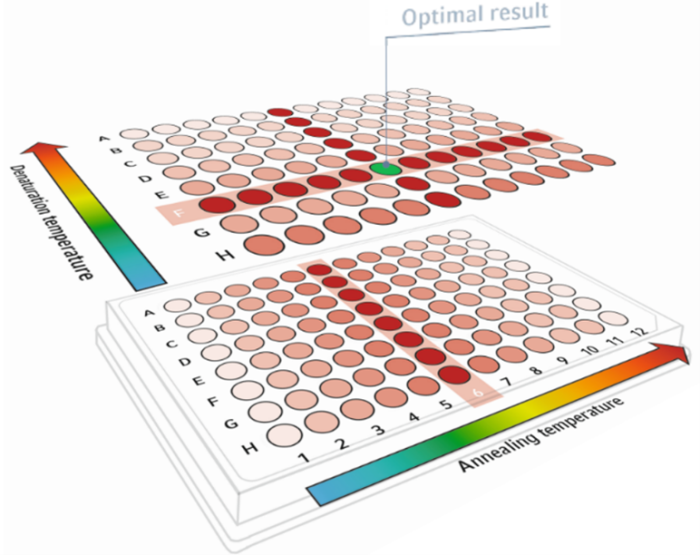
Figure 1: 2D-Gradient function can be used in a matrix-style optimization of both denaturation and annealing temperatures to find the optimal condition for a PCR. A temperature range of up to 30°C can be specified for each gradient. Usually, the annealing temperature is used as the first dimension and the denaturation temperature as second dimension, but they can also be used vice versa.
Why is an optimization of annealing and denaturation temperature beneficial?
The optimization of both temperatures offers improved specificity and yield (Figure 2) resulting in several advantages. The optimal temperature combination can be selected according to the needs of your workflow.
The optimization of both temperatures offers improved specificity and yield (Figure 2) resulting in several advantages. The optimal temperature combination can be selected according to the needs of your workflow.
Read more
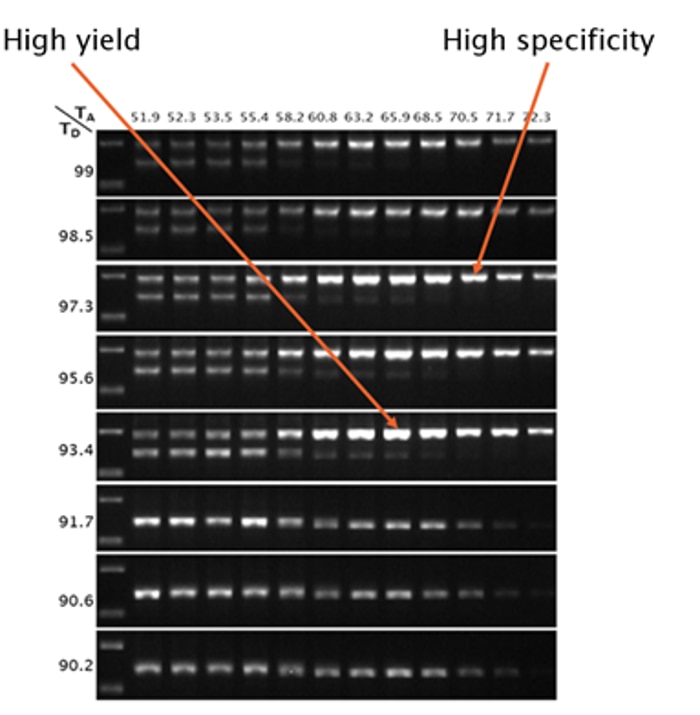
Figure 2: PCR optimization of ß-actin gene amplification with 2D-Gradient function.
Improved specificity:
• Clearer gel bands for publications
• Specific target DNA for post-PCR processing
• Less false-positive (unspecific) results
Improved yield:
• Faster PCR-protocol possible -> save time
• Lower reaction volume possible -> save money
• Can work with less template -> save money & work
• More DNA for downstream applications possible -> efficient workflow
• Get sufficient yield in difficult assays -> process stability
• Clearer gel bands for publications
• Specific target DNA for post-PCR processing
• Less false-positive (unspecific) results
Improved yield:
• Faster PCR-protocol possible -> save time
• Lower reaction volume possible -> save money
• Can work with less template -> save money & work
• More DNA for downstream applications possible -> efficient workflow
• Get sufficient yield in difficult assays -> process stability
Read more
Advantages of 2D- vs. 1D-Gradient
As described above, the 2D-Gradient function enables testing of 96 temperature combinations in a single PCR run. The optimization of ß-actin gene amplification shown in Figure 2 may have required eight PCR runs when using a thermal cycler with a 1D-Gradient function. Thus, the 2D-Gradient function helps to save time labor, reagents, consumables, and energy for temperature optimization. Furthermore, the results are more comparable as only a single mastermix, PCR plate, and sealing are needed when using the 2D-Gradient function (see Figure 3).
As described above, the 2D-Gradient function enables testing of 96 temperature combinations in a single PCR run. The optimization of ß-actin gene amplification shown in Figure 2 may have required eight PCR runs when using a thermal cycler with a 1D-Gradient function. Thus, the 2D-Gradient function helps to save time labor, reagents, consumables, and energy for temperature optimization. Furthermore, the results are more comparable as only a single mastermix, PCR plate, and sealing are needed when using the 2D-Gradient function (see Figure 3).
Read more
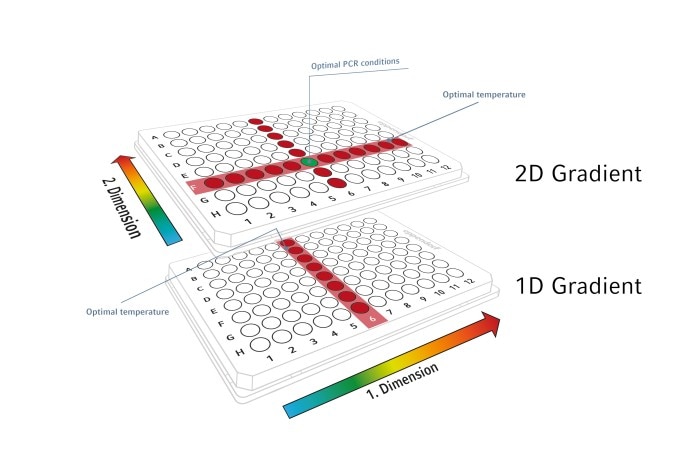
Figure 3: 2D- vs. 1D-Gradient. The 2D-Gradient enables to use two gradient steps in the same PCR run. The original 1D-Gradient gives 12 different temperatures horizontally across the thermoblock (some brand uses 8 temperatures across the rows from top to bottom strategy). With the new 2D-Gradient, the thermoblock can now additionally give 8 different temperatures vertically across the block.
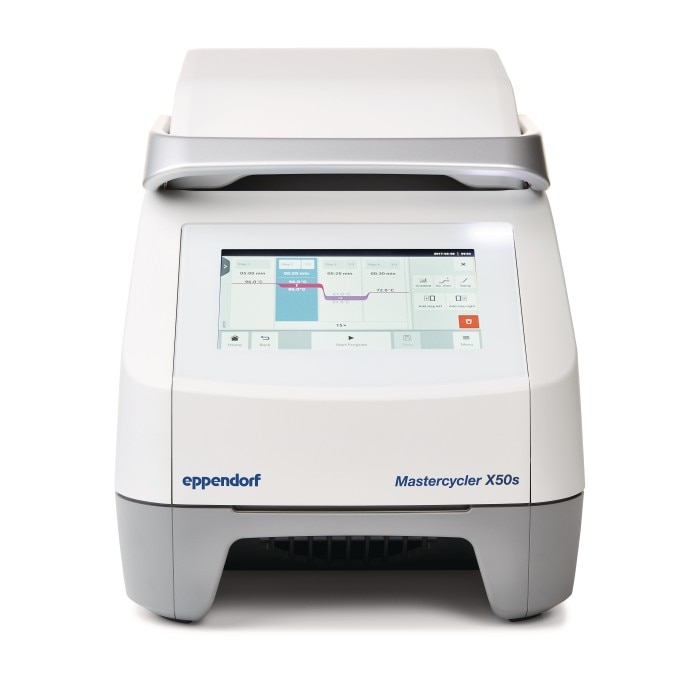
All variants of the Mastercycler X50 family are equipped with the 2D-Gradient function.
Read more
Links to Application Notes

Application Note
Application Note
Application Note